My First Encounter With the Reddit Authenticity Police
Today I learned something about Reddit.
Or maybe something about the internet in 2026.
I had written a piece about learning Polish. The argument was simple: Polish can be intimidating, speaking early helps, writing still matters, and learners should not wait until they understand every grammatical detail before they start using the language.
One sentence summed up part of the idea:
Speaking gives you fluency. Writing gives you precision.
I still think that is accurate.
Reddit had other plans.
The post took off faster than I expected
I created a Reddit account and posted a shortened, self-contained version of the article in a Polish-learning community.
No app links.
No sales pitch.
Eventually, no blog link either.
The idea was simply to make the post useful on its own.
And it worked.
The views came surprisingly quickly.
A few hundred became a thousand.
Then two thousand.
Then three.
After less than an hour, the post was approaching 4,000 views.
It eventually reached about 4,200.
For a small language-learning discussion, that felt like a lot.
Then one commenter appeared.
For convenience, I will call him the commenter.
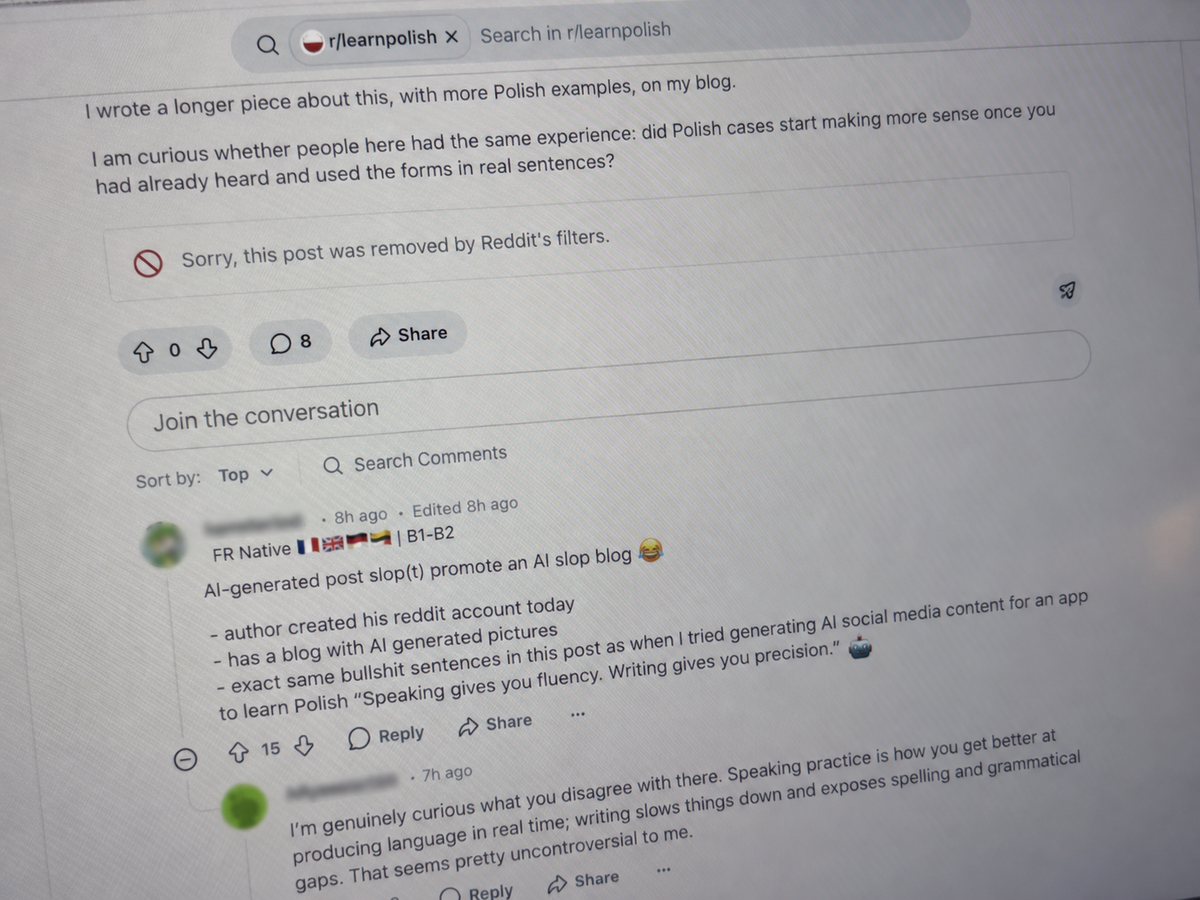
“AI-generated post slop”
The commenter had done some detective work.
He noticed that my Reddit account had been created that day.
He found my blog.
He noticed that some images there were AI-generated.
And from there, he concluded that the whole thing was:
“AI-generated post slop to promote an AI slop blog.”
He also singled out this sentence:
Speaking gives you fluency. Writing gives you precision.
Apparently, that kind of phrasing reminded him of AI-generated marketing text.
His comment quickly became the most-upvoted reply.
That was interesting.
Because the criticism was not really about the idea.
It was about the presumed origin of the wording.
I almost replied
For a while, I considered answering with something like:
What exactly do you think is wrong with the statement that speaking builds fluency while writing develops precision?
Because that is the part I cared about.
If the claim is wrong, explain why.
If it is right, then whether AI helped polish the wording is a different question.
In the end, I did not reply.
That was probably the right choice.
Once a discussion becomes about whether something is “AI slop,” it can stop being about the actual subject very quickly.
The uncomfortable part: he had noticed something real
I do use AI.
A lot.
I use it in software development.
I use it to explore ideas.
I use it for editing.
I use it for images.
And I use it as part of the writing process for this blog.
Pretending otherwise would be silly.
He had also correctly noticed the timing.
New Reddit account.
New blog post.
Polished text.
AI-generated images.
All on the same day.
That combination can look artificial.
So while I think his conclusion was lazy, I do think the reaction taught me something useful.
AI involvement and bad content are not the same thing
This is the part I find interesting.
Suppose AI helped tighten a sentence.
Does that make the sentence false?
I do not think so.
Speaking does help with producing language in real time.
Writing does force you to slow down and notice spelling, endings, grammar, and structure.
That remains true whether the sentence was drafted with a pen, in Word, or with an AI assistant.
The useful question should still be:
Is the idea good?
Not:
Was AI involved somewhere in the process?
Those are different questions.
But presentation matters
The internet has become very sensitive to writing that feels generated.
Sometimes people are right.
Sometimes they are wrong.
But the perception matters.
There are certain signals:
Very polished paragraph structure.
Neat contrasts.
Perfectly symmetrical sentences.
Generic but attractive images.
A brand-new account arriving with finished content.
Individually, none of those proves anything.
Together, they create a pattern.
And people notice patterns.
So the lesson for me is not to stop using AI.
It is to leave more of myself in the writing.
More specific observations.
More rough edges.
More personal examples.
More phrasing that sounds like something I would actually say.
Less of the feeling that every paragraph has been polished to the same shine.
The images matter too
This may be even more important than I expected.
AI-generated images have become technically impressive.
But many still have a certain look.
The light is too cooperative.
The people are arranged too neatly.
The background is too purposeful.
Nothing accidental is happening.
Real life is messier.
A slightly imperfect real photo can sometimes feel more trustworthy than a beautiful generated one.
That matters if the whole point of the article is authenticity.
So I will probably use fewer glossy AI-looking images going forward.
Not because AI images are automatically bad.
Because credibility is part of design too.
Then Reddit removed the post
A few hours later, the post was gone.
Reddit showed:
“Sorry, this post was removed by Reddit’s filters.”
By then, it had reached about 4,200 views.
I do not know exactly what happened.
Maybe someone reported it.
Maybe Reddit’s systems reevaluated the post because the account was new.
Maybe several signals combined.
I cannot prove the cause.
What I do know is that the post was visible for hours, generated discussion, got thousands of views, and was then removed.
That tells me something about how fragile a new account can be.
Reputation is a currency
Social platforms do not treat all users equally.
An old account has history.
Karma.
Comments.
Normal-looking activity.
Time.
A new account has none of that.
So even if the content is good, the account itself can look suspicious.
From Reddit’s point of view, that is understandable.
Spam accounts are new too.
Bots are new too.
Promotional accounts are new too.
But the result is that a newcomer has to accumulate trust before the platform fully believes them.
That is not necessarily fair, but it is how these systems work.
The lesson: slower may be better
My instinct as a developer is usually:
build fast,
publish fast,
test fast,
adjust fast.
That does not necessarily work well in social communities.
Creating an account and immediately posting polished content can itself be suspicious.
So perhaps the better strategy is slower.
Create the account.
Use it.
Wait.
Read.
Comment when you actually have something to say.
Post later.
Let time create credibility.
It is less efficient in the short term.
But maybe more effective in the long term.
Another lesson: keep promotion out of the post
This was useful too.
If I post again on Reddit, the rule will be simple:
No blog link.
No app link.
No “see my profile.”
No indirect nudge.
The post should stand completely on its own.
If someone becomes curious and clicks my profile, they can discover DevHome there.
That is enough.
The content should earn attention first.
Did the post fail?
Not really.
Around 4,200 people saw it.
Some apparently visited the blog.
People engaged with the idea.
One person disliked the entire thing.
Others did not.
And I learned a lot about how Reddit reacts to new accounts, AI-looking content, and polished writing.
That is useful information.
The experience also reminded me of something broader.
In 2026, it is no longer enough for something to be useful.
It also has to look like a real person had a reason to say it.
That is probably not an entirely bad standard.
I just do not think AI involvement automatically means there was no real person behind the idea.
About DevHome
DevHome is my one-person software studio. I build language-learning apps, experiment with AI, and write about what happens while trying to turn small software projects into something useful.
You can find my language apps at apps.devhome.no.
P.S. About the image
There was one slightly ironic problem left after writing this post.
I needed a picture for it.
Normally, I might generate one.
That would have been convenient.
It also would have been a spectacularly bad choice for an article partly about being accused of publishing AI-generated slop.
So I asked what image would fit.
The answer was basically:
Use a real screenshot.
Or take a quick photo of the laptop.
Something imperfect.
Something that actually happened.
My response was:
“So you mean I actually have to do some work myself?”
Unfortunately, yes.
And that may be the most appropriate ending to this whole story.
Sometimes the best way to prove there is a human behind the work is to leave a few fingerprints on it.